
An impact-focused trip to Capitol Hill



When Natalie Clark asked a question about the availability of federal housing vouchers during a policy session at the Family-Focused Treatment Association’s 2026 Public Policy Institute in Washington, D.C., she wasn’t speaking as an observer.
She is a child welfare expert. Clark spent six years in foster care, earned bachelor’s and master’s degrees in social work from the University of Utah, and has worked to make federal housing vouchers available to young people leaving foster care in her state. She is co-executive director and co-founder of the 1999 Collective, supporting transition-age youth in Utah.
Clark was participating in a whirlwind of meetings and briefings on Capitol Hill as a member of the National Collaborative for Transition-Age Youth. The group includes young adults like Clark, state and local child welfare policymakers and advocates and is supported by four national organizations: FosterClub, the American Public Human Services Association (APHSA), Embark Georgia Center and Youth Villages.
In D.C., the Collaborative’s goal was to inform and advocate. Earlier this year, it published a roadmap for improving services for former foster youth, developed over three years of co-design: Improving Outcomes for Young Adults and the Systems that Serve Them: A Playbook of Best Practices.
Members also shared copies of Creating Extended Foster Care that Works for All, a new Youth Voice Matters survey report from the Collaborative featuring young people with experience in extended foster care systems and the child welfare leaders who oversee the EFC systems that serve them.
Together, the two resources offered federal lawmakers insight into the needs of young people and the gaps in programs designed to support them.
Face-to-face meetings
Members of the collaborative divided into five teams, made up of young adults with experience in foster care, child welfare leaders and leads from Youth Villages, FosterClub and APHSA. In two days, members of the Collaborative met with 15 congressional offices to introduce the playbook and advocate for the federal portions of its key recommendations.
At the top of the agenda was legislation pending in Congress to modernize federal funding streams for transition-age youth services. The legislation was designed to improve the John H. Chafee Foster Care Program for Successful Transition to Adulthood, known simply as Chafee.
During a meeting with the staff of U.S. Rep. Don Bacon, R-Neb., members of the Collaborative emphasized the need for increases in Chafee funding, which has remained virtually unchanged decade after decade, even as young adults face significant inflation in the cost of housing, education and other necessities.
“Our ask is to think about whether we can bring Chafee funding to a level equivalent to what inflation would be in 2026,” a Collective member said. “How many more young people could we serve if we simply adjusted it for inflation?”
How many more young people could we serve if we simply adjusted it for inflation?
Passed by Congress in 1999, Chafee has been funded since at $143 million – an increase for inflation would bring the federal appropriation well over the $200 million mark and allow states to help many more young people.
Virginia Department of Social Services Administrator Monica Cabell discussed the challenges with stagnant funding for the Education and Training Voucher Program. Under current law, the vouchers are capped at $5,000 per year for Chafee eligible youth.
“It doesn’t really get you that far in this economy,” Cabell said.
The ETV program, which is part of Chafee, has been funded at $44 million. It would increase to $60 million under proposed legislation.
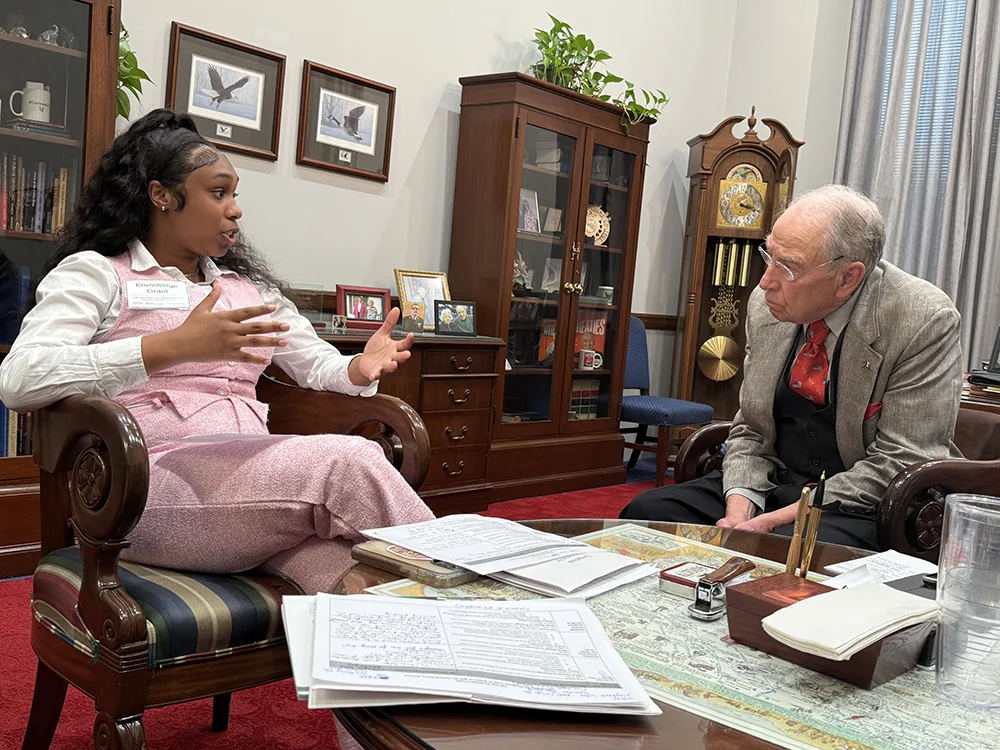
Knowledge Grant, a Collaborative member with lived experience in Florida’s foster care system, was part of a group that met with one of foster youth’s strongest champions on Capitol Hill: U.S. Sen. Chuck Grassley, R-Iowa, co-founder and co-chair of the bipartisan Senate Caucus on Foster Youth.
Grant told Sen. Grassley about her experience navigating federal housing assistance vouchers. Although she was able to access a voucher, the process required her to relocate from Tallahassee to Miami and endure periods of homelessness while trying to find housing the voucher would fund.
Grant encouraged greater flexibility in housing support programs and stronger support during transitions, particularly for young people who must relocate to access services.
The discussion also touched on the future of the Chafee program, prevention services and the challenges states face in aligning federal resources with local needs. Grassley welcomed continued dialogue from advocates, state leaders and, particularly, the young people themselves.
Several Collaborative members ended a day of advocacy together in the U.S. House gallery, watching the supporting speeches from foster youth champions like U.S. Rep. Danny Davis (D-Illinois) as the Chafee package, H.R. 7432, Fostering the Future Act, gained bipartisan support, was passed and moved to the Senate.
Importantly, no funding amount was attached to the legislation.
As we publish in late August, no action has been taken in the Senate, but the Chafee legislation should be part of end-of-year appropriation packages as Congress hits funding deadlines.
For more information about the National Collaborative for Transition-Age Youth, visit youthvillages.org/collaborative or email tay@youthvillages.org.
Share on Social